MAJOR QUESTION FOR NEXT WEEK: Will China buy more US Ags?
Archived sample · September 2026. Market conditions have changed since this was written; it's shown as an example of Chris's special reports, not current commentary.
Photo: USDA NRCS / Carly Whitmore
Next week, multiple Chinese officials travel to Washington DC for meetings with their US counterparts, and the item most important to our ag markets is this: Will China walk away with an agreement to buy $17 billion worth of US ag goods? The meetings begin Sunday with US Treasury Secretary Scott Bessent and US Trade Representative Jamieson Greer set to meet Chinese Vice Premier He Lifeng for final preparatory talks on trade, tariffs, rare earths, AI, and related issues. Chinese Foreign Minister Wang Yi and US Secretary of State Marco Rubio already held a phone call today (September 17) focused on high-level exchanges ahead of the visit. And then US President Donald Trump and Chinese President Xi Jinping are scheduled to meet at the White House on Thursday, September 24.
Let’s first review some background here: Following Trump’s visit to Beijing in April, the White House announced a $17 billion annual deal for ag products to go to China. This $17 billion annual amount is in addition to the US soybeans purchase agreement that China agreed to in October 2025. And reportedly, in exchange, China would get a break in tariffs, which we are told would add to $70-$80 billion annually. But, there is more than simple math that will complicate this deal:
There are three major themes that point towards no ag deal:
- The US and China have multiple other issues to deal with. AI, China giving aid to Iran, US stopping Iranian crude going to China, China trying to get rid of the US dollar as the global currency for trade, etc.
- China does not need or want any more feed grains. Their current corn prices are low, hog margins are bad, and corn import margins are negative. If they did actually want corn, Brazil and Argentina are cheaper.
- China is well into a 50 year master plan of doing whatever it can to destroy the US. So, it will continue to lie, cheat and steal and this meeting will not change that.
But there are three items that suggest an ag deal may occur.
- Given a WTO ruling against China in 2004, China has to allow 7.2 million tons of corn imports to occur under a 1% import tariff. So, some argue, if they have to allow corn to come in, why not US corn?
- Many have felt that China will do whatever is required to punt the ball further down the field and get past the next 2 years of Trump with the expectation that the next administration could be more friendly to China.
- If the agreement is that China spends $17 billion on US ag goods, then it gets $70-$80 billion break in tariffs, that math is simple.
But, at the end of the day, it’s still China. And the list of agreements China has broken is much too long to publish here. If they agree to anything, they may or may not ever follow through and actually do it.
I have put together some reasonable guesses of what China could purchase if they do agree to the $17 billion in US ag goods. And we quickly come to 2 conclusions: 1. The $17 billion will very likely have to include soybeans. And 2. If the agreement includes corn, it will take at least 7 million tons to make much of a difference.
| Category | 2015 | 2016 | 2017 | 2018 | 2019 | 2020 | 2021 | 2022 | 2023 | 2024 | 2025 | 2026 Jan-Jul |
Annual Amount |
% of last 3 yr avg |
Notes | Current Port Price |
|---|---|---|---|---|---|---|---|---|---|---|---|---|---|---|---|---|
| Oilseeds and Products | 10,626 | 14,543 | 12,378 | 3,252 | 8,139 | 14,427 | 14,324 | 18,080 | 15,243 | 12,803 | 3,131 | 5,090 | 2,850 | |||
| Soybeans | 10,489 | 14,203 | 12,224 | 3,119 | 8,005 | 14,066 | 14,116 | 17,917 | 15,057 | 12,637 | 2,996 | 4,915 | 2,650 | 26% | 5 mmt | $530 per mt |
| Other Oilseed or Products | 137 | 340 | 154 | 133 | 134 | 361 | 208 | 163 | 186 | 166 | 135 | 175 | 200 | 123% | ||
| Grains and feeds | 4,889 | 2,593 | 2,115 | 1,332 | 888 | 3,721 | 8,744 | 8,844 | 4,304 | 2,984 | 874 | 1,381 | 4,105 | 151% | ||
| Corn | 163 | 40 | 142 | 50 | 55 | 1,240 | 5,057 | 5,211 | 1,631 | 331 | 2 | 7 | 1,785 | 273% | 7 mmt | $255 per MT |
| Sorghum | 2,115 | 1,030 | 838 | 521 | 186 | 1,145 | 1,781 | 1,813 | 1,194 | 1,232 | 86 | 883 | 690 | 82% | 3 mmt | $230 per MT |
| Wheat | 160 | 205 | 351 | 106 | 56 | 570 | 768 | 392 | 390 | 441 | 16 | 66 | 630 | 223% | 2 mmt | SRW $315 per mt |
| Other Grain and Feed | 2,451 | 1,318 | 784 | 655 | 591 | 766 | 1,138 | 1,428 | 1,089 | 980 | 770 | 425 | 1,000 | 106% | don’t want DDG's | |
| Dairy and Products | 452 | 387 | 577 | 498 | 373 | 539 | 701 | 803 | 607 | 584 | 523 | 314 | 750 | 131% | ||
| Poultry and Products | 74 | 46 | 53 | 65 | 22 | 774 | 911 | 1,113 | 753 | 542 | 292 | 176 | 750 | 142% | ||
| Livestock and Meats | 1,888 | 1,844 | 1,810 | 1,403 | 2,022 | 3,252 | 4,204 | 4,363 | 3,860 | 3,481 | 1,911 | 912 | 4,000 | 130% | More organs and hides, higher price | |
| Tobacco and Products | 198 | 172 | 163 | 158 | 3 | 0 | 170 | 178 | 228 | 242 | 234 | 35 | 250 | 107% | ||
| Cotton, Linters, and Waste | 860 | 554 | 978 | 926 | 707 | 1,826 | 1,333 | 2,792 | 1,552 | 1,475 | 216 | 188 | 2,000 | 185% | More from US, less others, price up 25% | |
| Horticultural Products | 1,000 | 1,040 | 1,165 | 1,250 | 1,460 | 1,603 | 1,933 | 1,644 | 2,072 | 2,010 | 893 | 635 | 2,200 | 133% | ||
| Sugar and Tropical | 122 | 114 | 105 | 133 | 111 | 92 | 107 | 95 | 99 | 131 | 121 | 79 | 150 | 128% | ||
| Planting Seeds | 119 | 88 | 131 | 146 | 126 | 120 | 181 | 121 | 111 | 157 | 79 | 37 | 150 | 130% | ||
| Ethanol and Products | 135 | 313 | 83 | 82 | dash (zero) | 51 | 162 | 2 | 1 | 1 | 1 | 1 | 5 | 500% | ||
| Total | 20,363 | 21,694 | 19,558 | 9,245 | 13,851 | 26,405 | 32,770 | 38,035 | 28,830 | 24,410 | 8,275 | 8,848 | 17,210 |
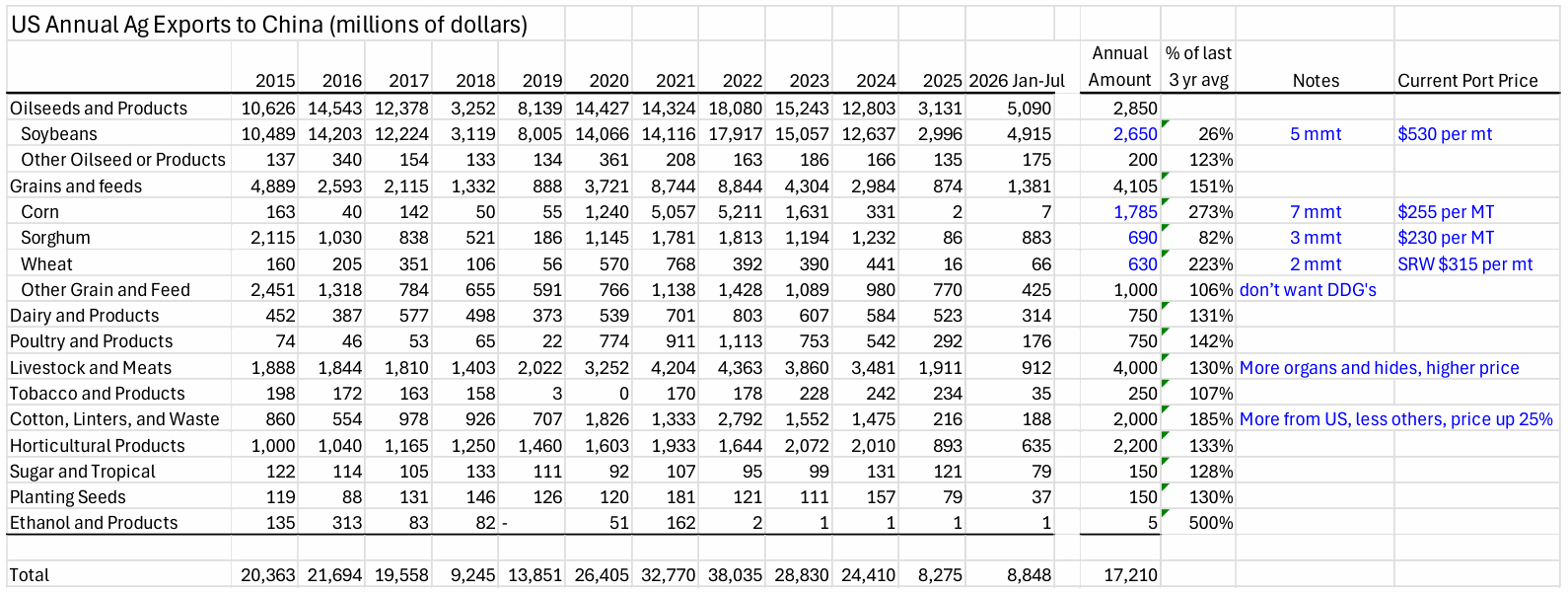
As for meats, we expect more chicken parts and beef organs and cattle hides, but it’s hard to argue for more high value meal cuts. They don’t want them and don’t need them today.
Summary: If, and that is a big IF, China does agree to buy $17 billion of US ag goods per year, and they actually follow through and do it, then that is bullish US corn, soybeans, and wheat. And as such, next week these markets will be ULTRA SENSITIVE to any Chinese news.
Please let me know if there are any questions.
Chris Myers
M6 Capital Management, LLC
Germantown, TN
Published in full with permission as an archived sample. Subscriber editions are licensed to the recipient only and may not be forwarded or redistributed.
Interested in the daily letter? Ask Chris about joining